"Cap" is short for market capitalisation: a company's share price multiplied by the number of its shares. It is the stock market's price for the whole company.
In many countries, large cap and small cap are loose labels that each broker or index provider defines for itself. India is different. Since 2017 there has been one definition that every mutual fund must follow, based on rank and not on a rupee amount.
The three categories
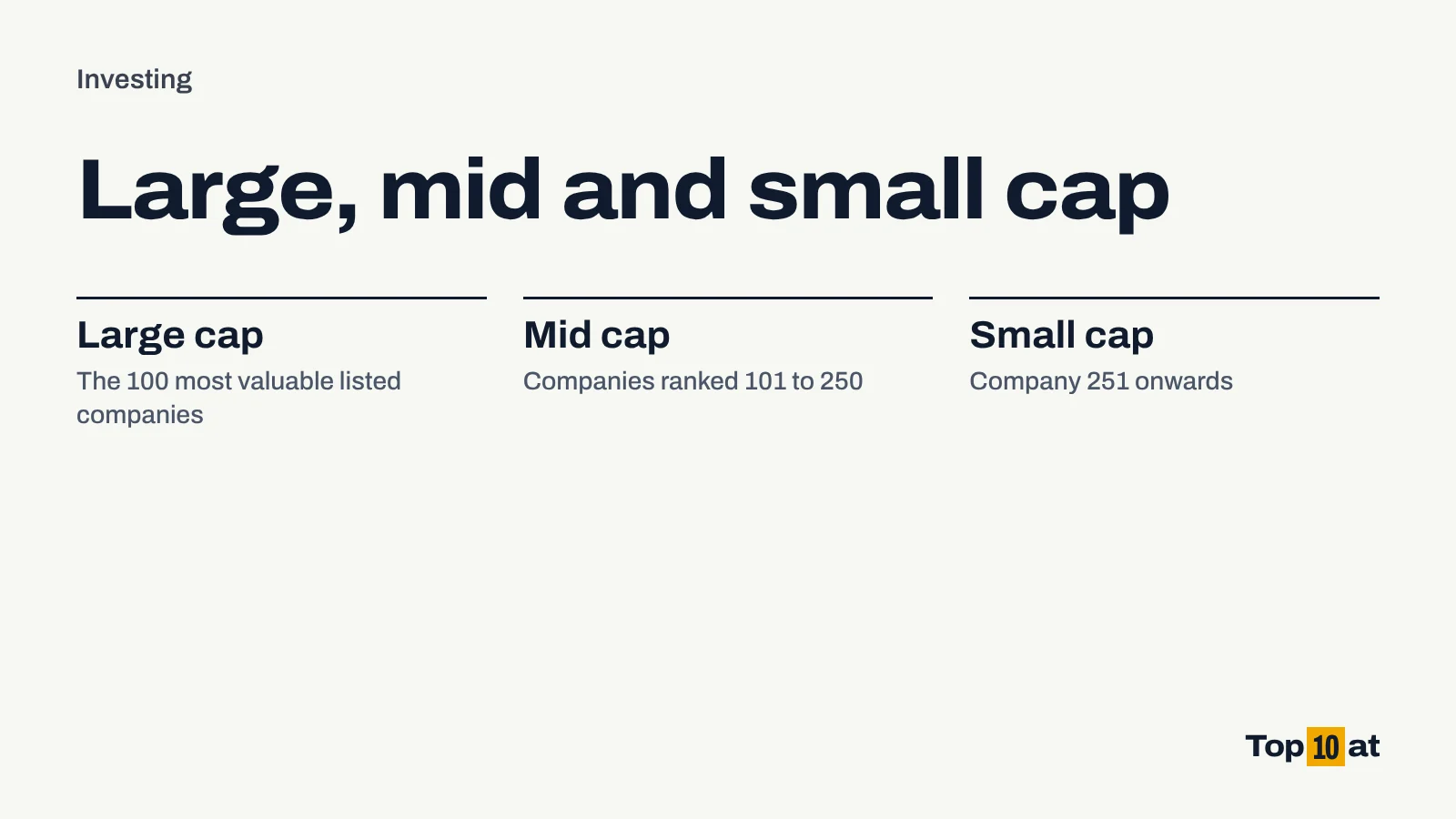
| Category | SEBI definition | Number of companies |
|---|---|---|
| Large cap | 1st to 100th company by full market capitalisation | 100 |
| Mid cap | 101st to 250th company | 150 |
| Small cap | 251st company onwards | All the rest |
The definition uses rank, so the number of large-cap companies never changes. There are always exactly 100. What changes is which companies they are, and how big a company has to be to make the cut.
Who prepares the list, and how
SEBI gave the job to AMFI, the mutual fund industry's association. The method is set out in the same circular:
- AMFI takes each company's full market capitalisation, averaged over six months.
- If a stock trades on more than one recognised exchange, AMFI averages its market capitalisation across those exchanges.
- The list is updated every six months, using data to the end of June and the end of December.
- AMFI publishes it within five calendar days of the end of each period.
- Mutual funds then have one month to adjust their portfolios to the new list.
Using a six-month average instead of a single day's price stops a short-lived jump or fall in a share from changing a company's category.
Where the cut-offs are now
The current list covers the six months ended 30 June 2026. These are the companies on either side of each boundary.
| Rank | Company | Average market capitalisation | Category under the rule |
|---|---|---|---|
| 1st | Reliance Industries | ₹18.73 lakh crore | Large cap |
| 100th | GAIL (India) | ₹1.06 lakh crore | Large cap (the last one) |
| 101st | Bosch | ₹1.06 lakh crore | Mid cap (the first one) |
| 250th | Godrej Industries | ₹33,664 crore | Mid cap (the last one) |
| 251st | Navin Fluorine International | ₹33,442 crore | Small cap (the first one) |
Two things are worth noticing.
The gaps at the boundaries are tiny. GAIL, the last large cap, and Bosch, the first mid cap, are separated by ₹68 crore, less than a tenth of one percent of either company's value. Which side of the line a company lands on can come down to very little.
The categories are very wide. The largest large cap, Reliance Industries, is worth about 18 times as much as the smallest. A label such as "large cap" tells you a company is in the top 100. It does not tell you the companies in it are alike.
Companies move between categories
Every new list moves some companies up and some down. In the list for the first half of 2026:
- Dr. Reddy's Laboratories went from 100th to 104th, which takes it from large cap to mid cap, even though its average value rose slightly.
- Indian Bank went from 107th to 89th and became a large cap.
- Hexaware Technologies went from 211th to 254th, from mid cap to small cap.
A company can change category without its own value changing much, because the ranking is relative. If others grow faster, it slips. Our rankings of the largest companies, banks, pharmaceutical companies and IT companies show where each one stands.
Why the definition matters to investors
The rule exists so that a mutual fund's name means something. A scheme that calls itself a large-cap fund has to invest mainly in the 100 companies on the list, and a mid-cap or small-cap fund in theirs. SEBI's circular was issued to bring uniformity, so that schemes with the same label can be compared across fund houses.
When the list changes, funds may have to buy or sell shares to stay within their category, which is why they are given a month to do it.
The labels describe size and nothing else. They do not say whether a company is profitable, well run or fairly priced, and they are not a guide to risk on their own. This page explains the terms. It is not investment advice.
Frequently asked questions
What is a large-cap company in India?
One of the 100 largest listed companies by full market capitalisation, according to the list AMFI publishes twice a year under SEBI's rules.
What is the market cap of a mid-cap company?
There is no fixed rupee range. Mid cap means rank 101 to 250. In the list for January to June 2026 that ran from about ₹1.06 lakh crore down to about ₹33,664 crore.
How many small-cap companies are there?
Every listed company ranked 251 or lower is small cap, so the number depends on how many companies are listed. AMFI's current list runs to more than 600 companies.
How often does the large-cap list change?
Twice a year. AMFI publishes a new list after the end of June and after the end of December.
Who decides which companies are large cap?
SEBI set the definition. AMFI applies it and publishes the list, using average market capitalisation data from the stock exchanges.
Sources
- Categorization and Rationalization of Mutual Fund Schemes, circular SEBI/HO/IMD/DF3/CIR/P/2017/114, 6 October 2017, Securities and Exchange Board of India (SEBI). amfiindia.com. Accessed 11 October 2026. Defines large, mid and small cap and how AMFI prepares the list.
- Average market capitalisation of listed companies during the six months ended 30 June 2026, Association of Mutual Funds in India (AMFI). portal.amfiindia.com. Accessed 11 October 2026. Source of every market capitalisation figure and rank in this article.
- Average market capitalisation of listed companies during the six months ended 31 December 2025, Association of Mutual Funds in India (AMFI). amfiindia.com. Accessed 11 October 2026. Used for the comparison with the previous six months.