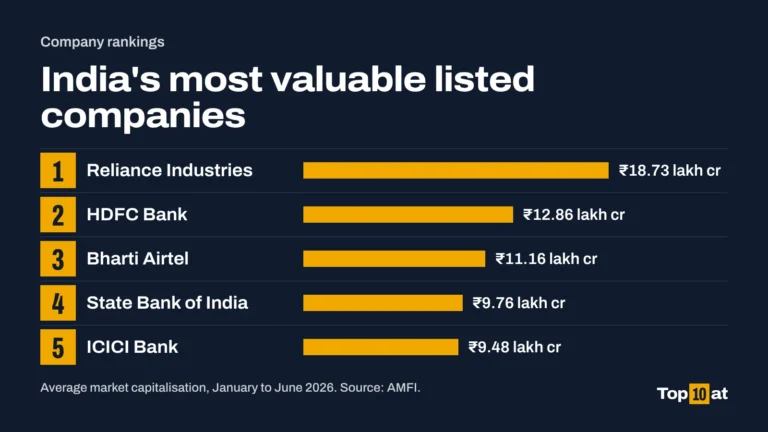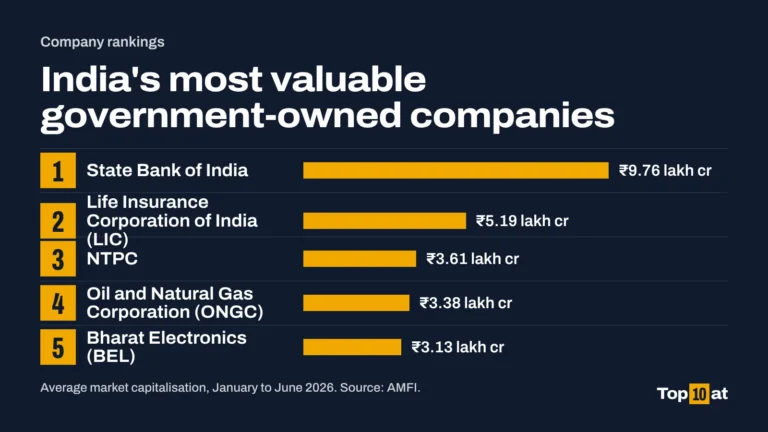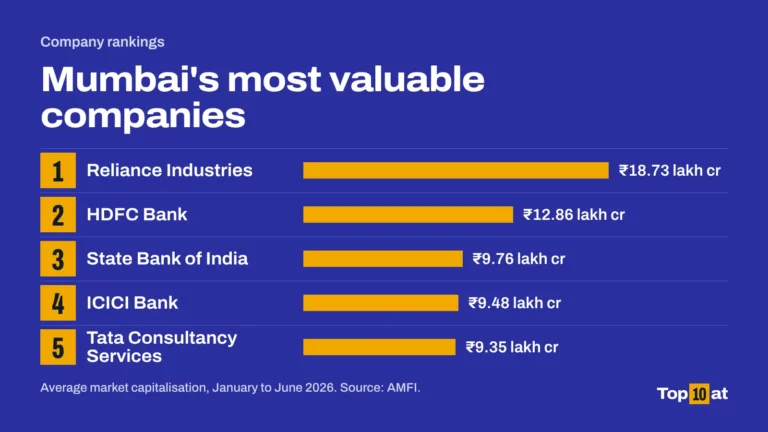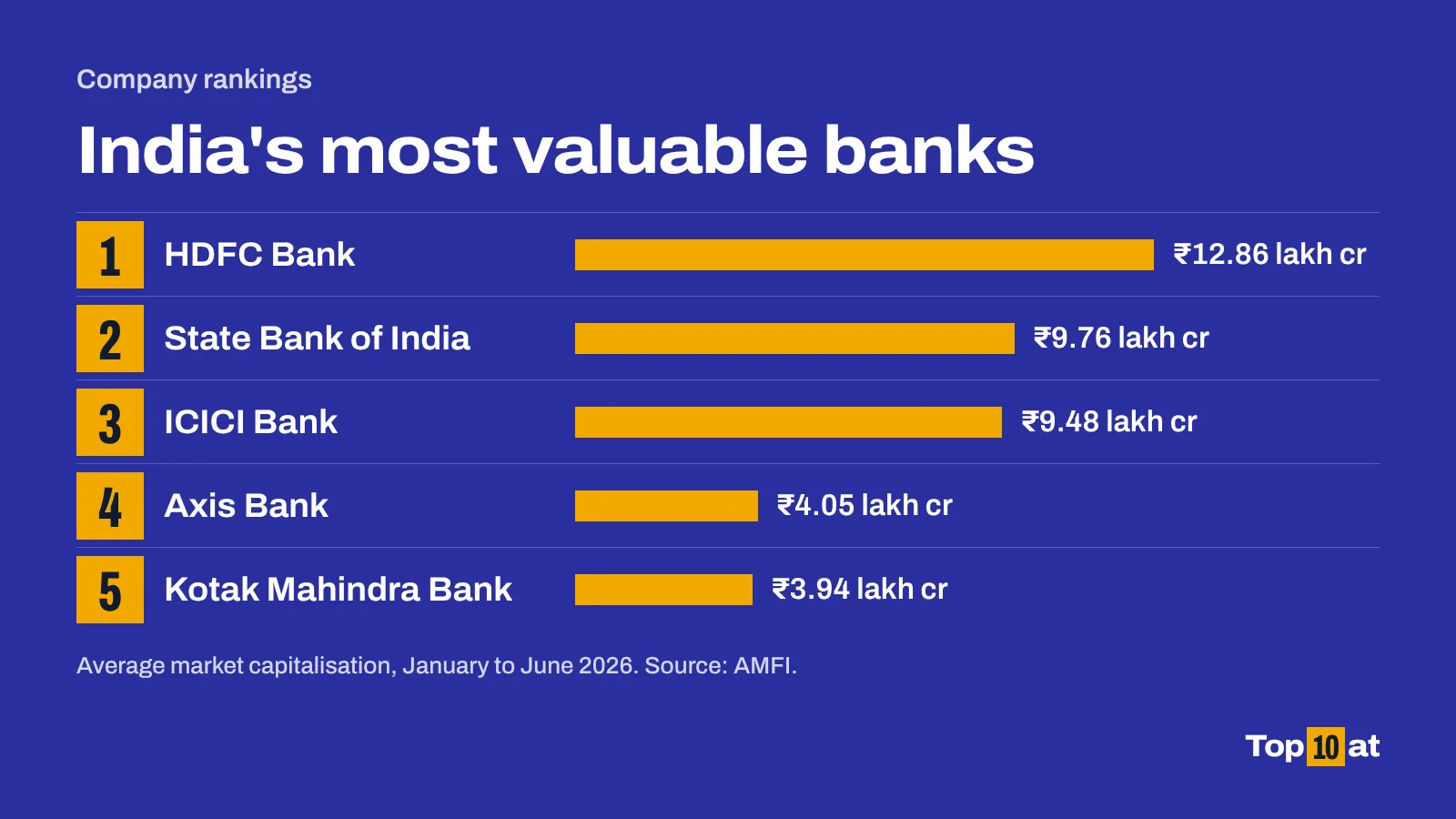
There is more than one way to rank banks. State Bank of India is the country's largest bank. But by what the stock market says the whole bank is worth, HDFC Bank leads. This ranking uses that second measure: the six-month average market capitalisation that the Association of Mutual Funds in India (AMFI) publishes for every listed company.
The ten banks below were worth ₹46.67 lakh crore between them on average from January to June 2026, almost exactly what the same ten were worth in the previous six months (₹46.88 lakh crore).
How this ranking works
- Measure. Average full market capitalisation for the six months ended 30 June 2026, as published by the Association of Mutual Funds in India (AMFI). For a company that trades on more than one exchange, AMFI averages the figures across exchanges.
- Who can appear. Banks listed on a recognised Indian stock exchange, both private sector and public sector. Non-bank lenders such as Bajaj Finance are not included, and nor are banks that are not listed.
- Comparison. Rises and falls are measured against AMFI's previous list, for the six months ended 31 December 2025.
- What we changed. Nothing. The values are AMFI's. We filtered its all-company list to this group, converted crore to lakh crore and rounded.
- What it does not tell you. Sales, profit, or whether a share is worth buying. Market value records what investors paid in that period. It is not a forecast.
| Rank | Name | Average market cap | Industry | Headquarters | Founded |
|---|---|---|---|---|---|
| 1 | HDFC Bank | ₹12.86 lakh crore | Private sector bank | Mumbai | 1994 |
| 2 | State Bank of India | ₹9.76 lakh crore | Public sector bank | Mumbai | 1955 |
| 3 | ICICI Bank | ₹9.48 lakh crore | Private sector bank | Mumbai | 1994 |
| 4 | Axis Bank | ₹4.05 lakh crore | Private sector bank | Mumbai | 1993 |
| 5 | Kotak Mahindra Bank | ₹3.94 lakh crore | Private sector bank | Mumbai | 1985 |
| 6 | Bank of Baroda | ₹1.46 lakh crore | Public sector bank | Vadodara | 1908 |
| 7 | Union Bank of India | ₹1.34 lakh crore | Public sector bank | Mumbai | 1919 |
| 8 | Punjab National Bank | ₹1.32 lakh crore | Public sector bank | New Delhi | 1894 |
| 9 | Canara Bank | ₹1.27 lakh crore | Public sector bank | Bengaluru | 1906 |
| 10 | Indian Bank | ₹1.18 lakh crore | Public sector bank | Chennai | 1907 |
The 10 largest banks in India
Ranked by average market cap. Figures as of 30 June 2026.
- 1
HDFC Bank
The most valuable bank in India
- Average market cap
- ₹12.86 lakh crore
- Headquarters
- Mumbai
- Founded
- 1994
- Industry
- Private sector bank
- Listing
- NSE: HDFCBANK
HDFC Bank is the most valuable bank in India and the second most valuable listed company of any kind. It was incorporated in 1994, promoted by the housing lender HDFC, and began operations in January 1995.
It is still well ahead, but less so than before. Its average value was down 15.2%, while State Bank of India's rose, and the gap between first and second narrowed from ₹5.17 lakh crore to ₹3.11 lakh crore.
- 2
State Bank of India
The largest public sector bank
- Average market cap
- ₹9.76 lakh crore
- Headquarters
- Mumbai
- Founded
- 1955
- Industry
- Public sector bank
- Listing
- NSE: SBIN
SBI moved from third to second among banks, passing ICICI Bank. Its average value was up 21.2%, which also took it from sixth to fourth among all listed companies.
The Government of India owns about 55.5% of SBI. The bank took its present name in 1955 and traces its history to the Bank of Calcutta, founded in 1806.
- 3
ICICI Bank
Private sector bank
- Average market cap
- ₹9.48 lakh crore
- Headquarters
- Mumbai
- Founded
- 1994
- Industry
- Private sector bank
- Listing
- NSE: ICICIBANK
ICICI Bank is the second-largest private sector bank by market value. It was incorporated in 1994 by ICICI, a development finance institution set up in 1955. Its head office is in Mumbai and its registered office is in Vadodara.
Its average value was down 5.0%. SBI and ICICI Bank are close: ₹27,270 crore separates second from third.
- 4
Axis Bank
Private sector bank, founded as UTI Bank
- Average market cap
- ₹4.05 lakh crore
- Headquarters
- Mumbai
- Founded
- 1993
- Industry
- Private sector bank
- Listing
- NSE: AXISBANK
Axis Bank was founded in 1993 as UTI Bank. It was the only private sector bank in the top five to gain value: its average was up 11.6%.
That moved it past Kotak Mahindra Bank into fourth place. In the previous list Kotak was ahead by ₹52,335 crore.
- 5
Kotak Mahindra Bank
Private sector bank founded by Uday Kotak
- Average market cap
- ₹3.94 lakh crore
- Headquarters
- Mumbai
- Founded
- 1985
- Industry
- Private sector bank
- Listing
- NSE: KOTAKBANK
Kotak Mahindra began in 1985 as a bill discounting firm and received a banking licence from the Reserve Bank of India in 2003. Uday Kotak, the founder, remains on the board as a non-executive director.
Its average value was down 5.2%. After Kotak the list drops sharply: it is worth 2.7 times as much as Bank of Baroda in sixth place.
- 6
Bank of Baroda
Public sector bank founded in Vadodara
- Average market cap
- ₹1.46 lakh crore
- Headquarters
- Vadodara
- Founded
- 1908
- Industry
- Public sector bank
Bank of Baroda is the second most valuable public sector bank after SBI. Sayajirao Gaekwad III, the ruler of Baroda, founded it in 1908, and it was nationalised in 1969. The government owns about 64%.
Its average value was up 8.1%.
- 7
Union Bank of India
Public sector bank
- Average market cap
- ₹1.34 lakh crore
- Headquarters
- Mumbai
- Founded
- 1919
- Industry
- Public sector bank
- Listing
- NSE: UNIONBANK
Union Bank had the largest rise in the list. Its average value was up 22.7%, which took it from ninety-fifth to seventy-fifth among all listed companies and past both Punjab National Bank and Canara Bank.
It was established in 1919 and nationalised in 1969. Corporation Bank and Andhra Bank merged into it with effect from 1 April 2020. The government owns about 74.8%.
- 8
Punjab National Bank
Public sector bank, the oldest in this list
- Average market cap
- ₹1.32 lakh crore
- Headquarters
- New Delhi
- Founded
- 1894
- Industry
- Public sector bank
- Listing
- NSE: PNB
PNB was founded in May 1894. Among the ten, only SBI has older roots, through its predecessor the Bank of Calcutta. The government owns about 70.1%, and the bank is based in New Delhi.
Its average value hardly moved, up 0.5%, so it slipped from seventieth to seventy-eighth overall as other banks rose around it.
- 9
Canara Bank
Public sector bank founded in Mangaluru
- Average market cap
- ₹1.27 lakh crore
- Headquarters
- Bengaluru
- Founded
- 1906
- Industry
- Public sector bank
- Listing
- NSE: CANBK
Ammembal Subba Rao Pai founded Canara Bank in Mangaluru in 1906. It was nationalised in 1969 and is now headquartered in Bengaluru.
Its average value was up 11.4%. Union Bank, PNB and Canara Bank are bunched together, with ₹6,363 crore between seventh and ninth.
- 10
Indian Bank
Public sector bank
- Average market cap
- ₹1.18 lakh crore
- Headquarters
- Chennai
- Founded
- 1907
- Industry
- Public sector bank
- Listing
- NSE: INDIANB
Indian Bank is the new entrant. It was 107th among all listed companies in the previous list, which made it a mid-cap stock, and is 89th now, which makes it large cap. Its average value was up 18.6%.
It was established in 1907, is headquartered in Chennai, and has been government-owned since 1969. It replaces IDBI Bank, whose average value fell from ₹1.03 lakh crore to ₹94,172 crore.
What changed since the last list
The total barely changed, but the split did. The six public sector banks all gained value and together rose 17.1%. The four private sector banks together fell 7.9%, with only Axis Bank rising.
| Company | All-India rank, Jul to Dec 2025 | All-India rank, Jan to Jun 2026 | Average value, Jul to Dec 2025 | Average value, Jan to Jun 2026 | Change |
|---|---|---|---|---|---|
| HDFC Bank | 2nd | 2nd | ₹15.16 lakh crore | ₹12.86 lakh crore | −15.2% |
| State Bank of India | 6th | 4th | ₹8.05 lakh crore | ₹9.76 lakh crore | +21.2% |
| ICICI Bank | 5th | 5th | ₹9.99 lakh crore | ₹9.48 lakh crore | −5.0% |
| Axis Bank | 18th | 15th | ₹3.63 lakh crore | ₹4.05 lakh crore | +11.6% |
| Kotak Mahindra Bank | 16th | 16th | ₹4.15 lakh crore | ₹3.94 lakh crore | −5.2% |
| Bank of Baroda | 66th | 58th | ₹1.35 lakh crore | ₹1.46 lakh crore | +8.1% |
| Union Bank of India | 95th | 75th | ₹1.09 lakh crore | ₹1.34 lakh crore | +22.7% |
| Punjab National Bank | 70th | 78th | ₹1.31 lakh crore | ₹1.32 lakh crore | +0.5% |
| Canara Bank | 82nd | 80th | ₹1.14 lakh crore | ₹1.27 lakh crore | +11.4% |
| Indian Bank | 107th | 89th | ₹99,684 crore | ₹1.18 lakh crore | +18.6% |
What the list tells you
Private banks are fewer but worth more
The four private sector banks account for 65% of the list's value and the six public sector banks for 35%. Six months earlier the split for the same ten banks was 70% to 30%.
Three banks are two-thirds of the total
HDFC Bank, SBI and ICICI Bank make up 69% of the combined value. The five banks ranked sixth to tenth together make up 14%, less than Axis Bank and Kotak Mahindra Bank combined.
All ten are large cap
Every bank in the list is among the 100 most valuable listed companies in India. Indian Bank, in tenth place, crossed into that group in this period.
Six are based in Mumbai
HDFC Bank, SBI, ICICI Bank, Axis Bank, Kotak Mahindra Bank and Union Bank of India have their headquarters in Mumbai. The other four are in Vadodara, New Delhi, Bengaluru and Chennai.
Who just missed the list
IDBI Bank was tenth in the previous list and is eleventh now. The next four are a mix of private sector banks, a small finance bank and another public sector bank, all mid cap.
| Company | All-India rank | Average market cap |
|---|---|---|
| IDBI Bank | 116th | ₹94,172 crore |
| AU Small Finance Bank | 145th | ₹73,398 crore |
| Federal Bank | 150th | ₹70,658 crore |
| IndusInd Bank | 152nd | ₹69,581 crore |
| Bank of India | 155th | ₹68,756 crore |
Limits of this ranking
This is a six-month average that ended on 30 June 2026. It will not match the market capitalisation shown on a stock exchange or trading app today, and a company's position on any single day can differ from its position here.
Market value is one way to measure size. Ranked by revenue, profit, assets or number of employees, the list would look different. Nothing here is investment advice. AMFI publishes its next list, for July to December 2026, in early January 2027, and this page will be updated when it does.
Frequently asked questions
Which is the No. 1 bank in India?
It depends on the measure. By market capitalisation it is HDFC Bank, at ₹12.86 lakh crore on average over January to June 2026. State Bank of India is the largest public sector bank and is second by market value at ₹9.76 lakh crore.
Which is the largest private sector bank in India?
HDFC Bank, by market value. ICICI Bank is second among private sector banks at ₹9.48 lakh crore, followed by Axis Bank at ₹4.05 lakh crore and Kotak Mahindra Bank at ₹3.94 lakh crore.
Which is the largest government bank in India?
State Bank of India. Among public sector banks it is followed, by market value, by Bank of Baroda (₹1.46 lakh crore), Union Bank of India (₹1.34 lakh crore) and Punjab National Bank (₹1.32 lakh crore).
Is a bank with a higher market value safer for deposits?
Market capitalisation does not measure deposit safety. It is the stock market price of the bank's shares. Deposits in Indian banks are covered by deposit insurance up to a limit set by the Deposit Insurance and Credit Guarantee Corporation, whatever the bank's market value.
Why is Bajaj Finance not in this list?
Bajaj Finance is a non-banking financial company. It lends and takes deposits but does not hold a banking licence. By market value it would rank fourth here, between ICICI Bank and Axis Bank.
Sources
- Average market capitalisation of listed companies during the six months ended 30 June 2026, Association of Mutual Funds in India (AMFI). portal.amfiindia.com. Accessed 11 October 2026. Source of every market capitalisation figure and rank in this article.
- Average market capitalisation of listed companies during the six months ended 31 December 2025, Association of Mutual Funds in India (AMFI). amfiindia.com. Accessed 11 October 2026. Used for the comparison with the previous six months.
- Categorization and Rationalization of Mutual Fund Schemes, circular SEBI/HO/IMD/DF3/CIR/P/2017/114, 6 October 2017, Securities and Exchange Board of India (SEBI). amfiindia.com. Accessed 11 October 2026. Defines large, mid and small cap and how AMFI prepares the list.
- HDFC Bank, Wikipedia. en.wikipedia.org. Accessed 11 October 2026. Company background. Secondary source.
- State Bank of India, Wikipedia. en.wikipedia.org. Accessed 11 October 2026. Company background. Secondary source.
- ICICI Bank, Wikipedia. en.wikipedia.org. Accessed 11 October 2026. Company background. Secondary source.
- Axis Bank, Wikipedia. en.wikipedia.org. Accessed 11 October 2026. Company background. Secondary source.
- Kotak Mahindra Bank, Wikipedia. en.wikipedia.org. Accessed 11 October 2026. Company background. Secondary source.
- Bank of Baroda, Wikipedia. en.wikipedia.org. Accessed 11 October 2026. Company background. Secondary source.
- Union Bank of India, Wikipedia. en.wikipedia.org. Accessed 11 October 2026. Company background. Secondary source.
- Punjab National Bank, Wikipedia. en.wikipedia.org. Accessed 11 October 2026. Company background. Secondary source.
- Canara Bank, Wikipedia. en.wikipedia.org. Accessed 11 October 2026. Company background. Secondary source.
- Indian Bank, Wikipedia. en.wikipedia.org. Accessed 11 October 2026. Company background. Secondary source.