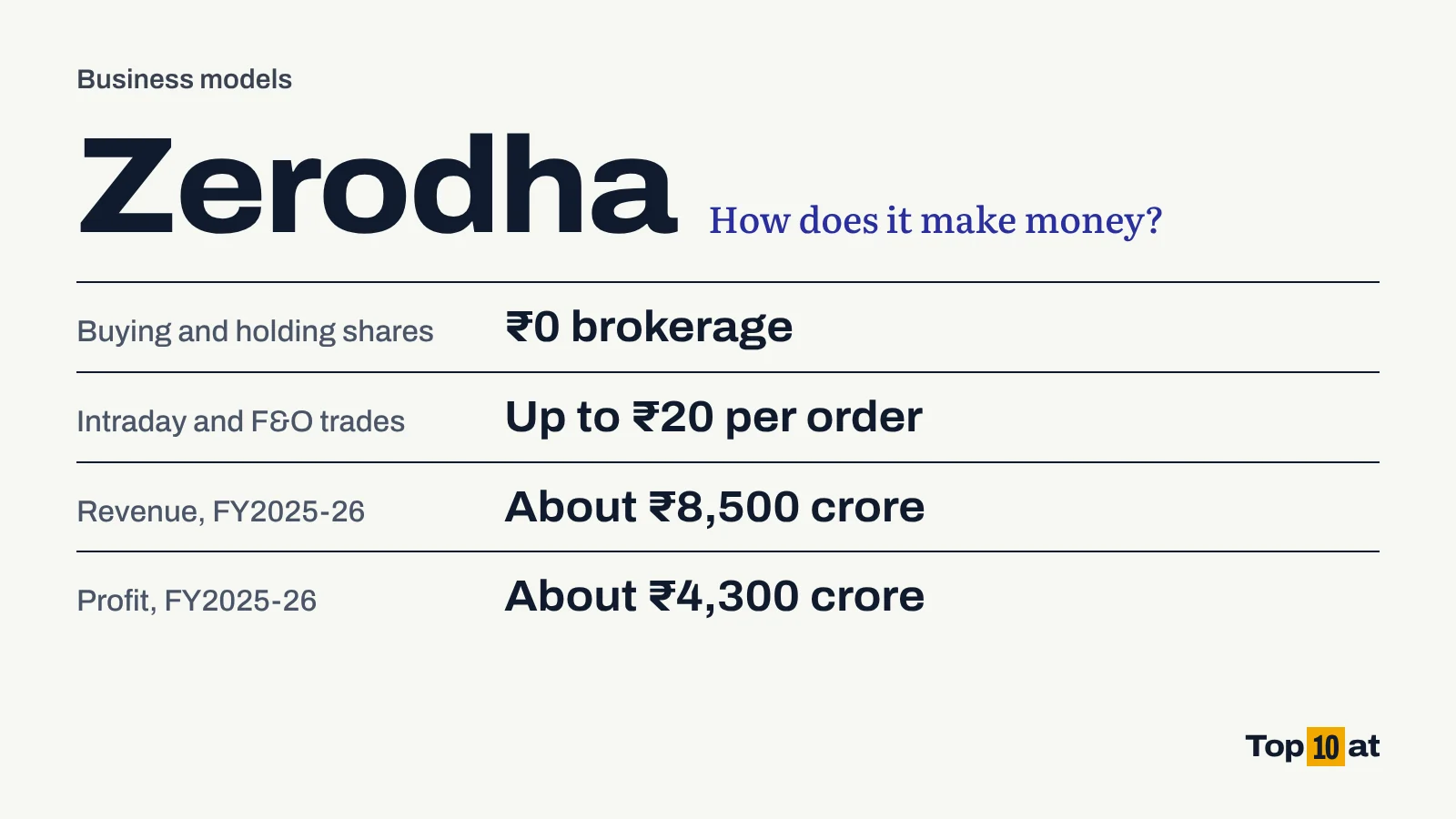
About ₹8,500 crore
Revenue, FY2025-26
About ₹4,300 crore
Net profit, FY2025-26
₹0
Brokerage on equity delivery
₹20
Maximum brokerage per order
Zerodha is a stockbroker based in Bengaluru. Brothers Nithin and Nikhil Kamath founded it in August 2010 as a discount broker, and the Kamath family owns all of it. The founders built it without venture capital, and it is not listed.
Because it is private, Zerodha does not publish full accounts in the way a listed company does. Its chief executive shares approximate figures in a blog post each year. For FY2025-26 those were revenue of about ₹8,500 crore and net profit of about ₹4,300 crore, both broadly the same as the year before.
How Zerodha makes money
| Source of income | What Zerodha charges |
|---|---|
| Equity delivery (buying shares to hold) | ₹0 brokerage |
| Equity intraday | 0.03% or ₹20 per executed order, whichever is lower |
| Futures (equity, currency, commodity) | 0.03% or ₹20 per executed order, whichever is lower |
| Options (equity, currency, commodity) | Flat ₹20 per executed order |
| Margin trading facility | Interest of 0.04% a day (₹40 per lakh) on the amount funded, plus brokerage of 0.3% or ₹20 per order |
| Interest on overdue balances | 18% a year |
| Depository charge when shares are sold | ₹15.34 per stock, of which ₹9.50 is Zerodha's fee |
| Account maintenance | Free for the first year, then up to ₹300 a year plus GST |
| Call and trade | ₹50 per order placed through a dealer |
| Direct mutual funds (Coin) | ₹0 |
Free for investors, paid for by traders
The offer that made Zerodha's name is zero brokerage on equity delivery, which means buying shares and keeping them. Opening an account is free for individuals, and investing in direct mutual funds through its Coin platform is free as well.
The company charges for trades that are opened and closed quickly or that use derivatives. The fee is capped at ₹20 an order however large the trade is, so a very active trader placing many orders a day pays many small fees. That is where a discount broker's brokerage income comes from.
Zerodha does not publish how its revenue divides between brokerage, interest and other charges, so this article does not put percentages on them.
Interest and account charges
Three other lines appear on the charge sheet.
- Margin trading. Zerodha lends customers money to buy shares and charges 0.04% a day on the amount funded, which is ₹40 a day for every ₹1 lakh.
- Overdue balances. A customer whose account goes into debit pays interest at 18% a year.
- Holding and servicing accounts. After the first year there is an annual maintenance charge of up to ₹300 plus GST. Each time a customer sells a stock from their demat account there is a depository charge of ₹15.34, of which ₹9.50 goes to Zerodha and the rest is the depository's fee and tax.
What keeps costs low
Zerodha's reported profit is about half its revenue, an unusually high share. Two features of the business help explain it. It is an online broker, built around its own trading platform, Kite. And it has no outside shareholders: the business was bootstrapped, and the founders' family still owns it outright.
Beyond broking, the group runs Coin for mutual funds, Varsity for investor education, and Rainmatter, a fund set up in 2014 that invests in start-ups. In October 2023 it launched Zerodha Fund House, an asset management company focused on index funds, in partnership with Smallcase.
Why revenue has stopped growing
A model that depends on active traders is exposed to anything that reduces trading. That is what happened in FY2025-26.
According to the report of his blog post, chief executive Nithin Kamath said the company "had to take revenue hits because of regulatory changes". He pointed to a higher securities transaction tax on options and fewer weekly options expiries, both of which reduce derivatives trading, and said market volumes had been falling since a peak in September 2024.
Revenue and profit were flat as a result. For a company that earns a fixed fee per order, fewer orders mean less income, and it cannot make up the difference by charging more per trade without giving up the low prices it is known for.
A note on the figures
Zerodha is a private company. The revenue and profit figures here are the approximate numbers its chief executive shared publicly, as reported by a news agency, and have not been taken from audited accounts. The charges are from Zerodha's own website.
Zerodha: company facts
Frequently asked questions
How does Zerodha make money if delivery is free?
From intraday and derivatives trades, which cost up to ₹20 per order, from interest on margin funding and overdue balances, and from account and depository charges.
What is Zerodha's brokerage?
Zero on equity delivery. On intraday and futures trades it is 0.03% or ₹20 per executed order, whichever is lower. On options it is a flat ₹20 per order.
How much profit does Zerodha make?
About ₹4,300 crore on revenue of about ₹8,500 crore in FY2025-26, according to figures shared by its chief executive.
Who owns Zerodha?
The Kamath family. Brothers Nithin and Nikhil Kamath founded the company in 2010, and the family owns 100% of it.
Is Zerodha listed on the stock market?
No. It is a privately held company.
Sources
- Zerodha brokerage charges, fees and taxes, Zerodha. zerodha.com. Accessed 11 October 2026. The full list of charges quoted in this article.
- Zerodha's FY26 revenue, profit stay flat at Rs 8,500 crore and Rs 4,300 crore, IANS, carried by The Hawk, 26 August 2026. thehawk.in. Accessed 11 October 2026. Approximate revenue and profit for FY2025-26 and the chief executive's comments. Report of a company blog post.
- Zerodha, Wikipedia. en.wikipedia.org. Accessed 11 October 2026. Founding, ownership and group businesses. Secondary source.