₹5,214.86 crore
Revenue from operations, FY2025-26
₹1,393.45 crore
Profit after tax
89%
Share of reserved rail tickets booked online
₹45,249 crore
Average market value, Jan to Jun 2026
The Indian Railway Catering and Tourism Corporation was set up in 1999 as a public sector company under the Ministry of Railways. It was listed on the stock exchanges in 2019, and the Government of India still owns about 62.4%.
Most people know IRCTC as the website and app for booking train tickets. That is one of four businesses, and not the biggest. In the year ended 31 March 2026 the company reported revenue from operations of ₹5,214.86 crore, up 11.55%, and profit after tax of ₹1,393.45 crore.
How IRCTC makes money
| Business | How it earns | Revenue, FY2025-26 | Share |
|---|---|---|---|
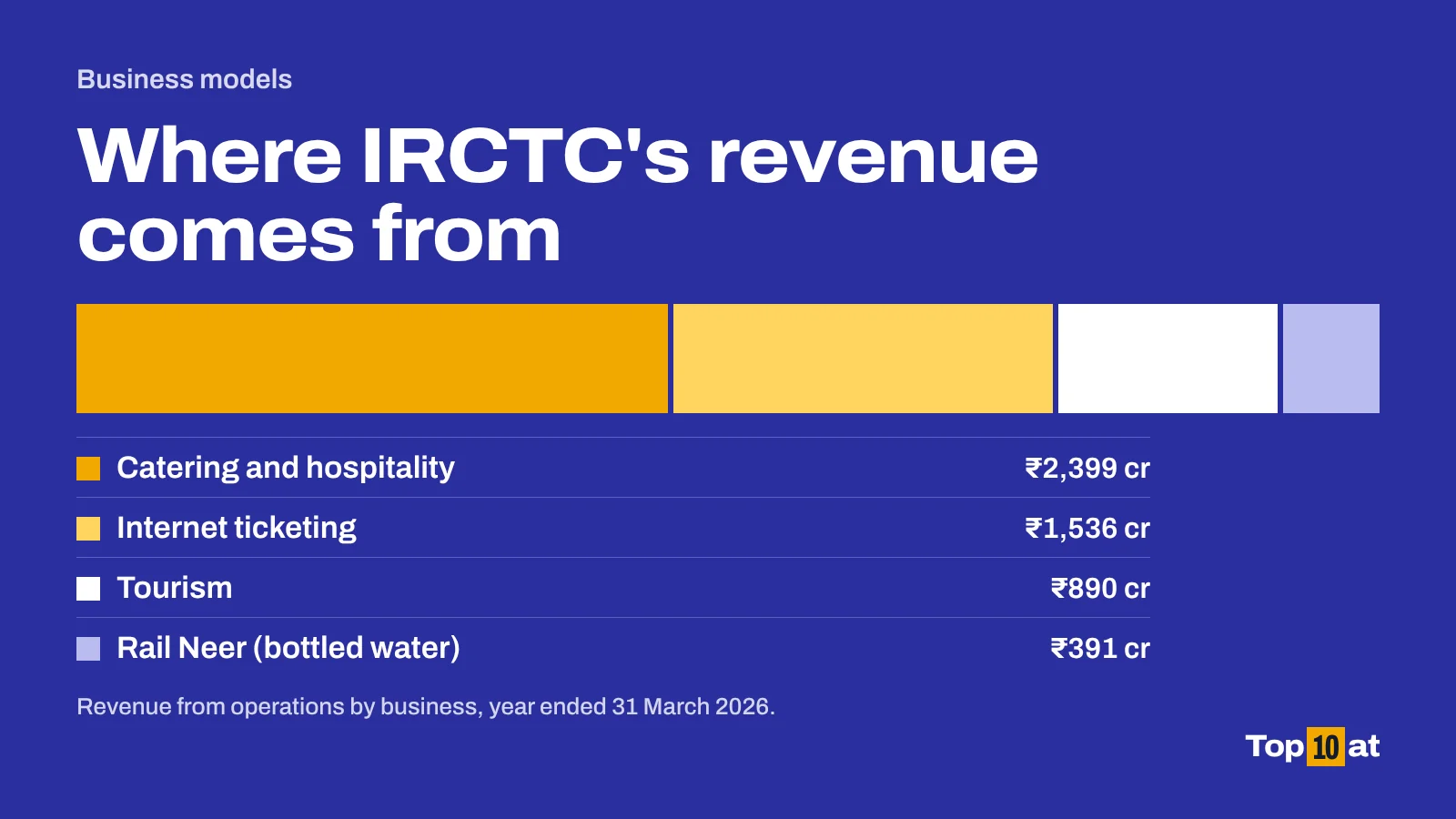
| Catering and hospitality | Meals on trains and at stations, sold directly or through licensed caterers | ₹2,398.75 crore | 46.0% |
| Internet ticketing | A convenience fee on each ticket booked on its website or app | ₹1,535.51 crore | 29.4% |
| Tourism | Tour packages, tourist trains and travel bookings | ₹890.08 crore | 17.1% |
| Rail Neer (bottled water) | Packaged drinking water sold on trains and at stations | ₹390.52 crore | 7.5% |
| Total | ₹5,214.86 crore | 100% |
Catering: the largest business
IRCTC has exclusive rights to cater on board all trains run by Indian Railways. It also runs food outlets at stations and, since 2014, an e-catering service that lets passengers order from private restaurants and have the food brought to their seats.
Catering and hospitality brought in ₹2,398.75 crore in FY2025-26, close to half of all revenue.
Internet ticketing: a small fee, many tickets
When you book a train ticket on IRCTC, the fare goes to Indian Railways. IRCTC's income is the convenience fee added on top. In a written reply to the Rajya Sabha in August 2025, the Railway Minister gave the fee as ₹10 for non-AC tickets and ₹20 for AC tickets booked online, and described it as covering the cost of running and upgrading the booking system.
The amounts are small but the volume is very large. About 89% of all reserved tickets on Indian Railways were booked online in FY2025-26. The platform had 70.6 million registered users as of August 2026.
Internet ticketing earned ₹1,535.51 crore in FY2025-26, 29% of revenue. IRCTC provides the online ticketing service for Indian Railways, so nearly every reserved ticket booked on the internet passes through it.
Tourism
IRCTC sells package tours for domestic and foreign travellers and operates some trains itself. In 2020 it began running the Lucknow to New Delhi Tejas Express, described as the first privately operated train in India, and later added the Ahmedabad to Mumbai Tejas Express and the Kashi Mahakal Express.
Tourism brought in ₹890.08 crore in FY2025-26.
Rail Neer
Rail Neer is IRCTC's own brand of packaged drinking water, launched in 2003 and sold on trains and at railway stations. It is the smallest of the four businesses, with revenue of ₹390.52 crore.
Why the model is unusual
Two things set IRCTC apart from an ordinary company.
First, it does not have to win its customers. Its catering rights are exclusive, and its ticketing platform handles about 89% of reserved bookings. Demand comes from the number of people who travel by train.
Second, it does not set its own terms. The convenience fee and the catering policy are decided by its majority owner, the government. A change in policy can raise or cut its income without any change in how well it runs the business.
That mix shows in the profit. IRCTC kept 27% of its revenue as profit after tax in FY2025-26, a high figure for a company whose largest business is food. Its board recommended a dividend of ₹9 a share, or ₹720 crore in total.
The stock market has been less generous lately. IRCTC's average market value fell from ₹57,370 crore in the second half of 2025 to ₹45,249 crore in the first half of 2026, down 21.1%, and it slipped from 182nd to 207th among all listed companies.
IRCTC: company facts
Frequently asked questions
How does IRCTC make money?
From catering on trains and at stations, a convenience fee on online tickets, tourism packages and Rail Neer bottled water. Catering was the largest in FY2025-26 at ₹2,398.75 crore.
Does IRCTC keep the train fare?
No. The fare goes to Indian Railways. IRCTC earns a convenience fee on tickets booked online: ₹10 for non-AC classes and ₹20 for AC classes, according to the Railway Minister's reply to Parliament in August 2025.
Is IRCTC a government company?
Yes. It is a public sector undertaking under the Ministry of Railways. The Government of India owns about 62.4%, and the rest of the shares trade on the stock exchanges.
Is IRCTC a monopoly?
It has exclusive rights to on-board catering on Indian Railways trains, and it provides the online ticketing service for Indian Railways, which handled about 89% of reserved bookings in FY2025-26. Its fees and policies are set by the government.
What is Rail Neer?
IRCTC's brand of packaged drinking water, launched in 2003 and sold on trains and at stations.
Sources
- IRCTC posts record revenue and dividend in fiscal 2026 (summary of the FY2025-26 annual report), FilingReader. filingreader.com. Accessed 11 October 2026. Revenue by segment, profit before tax, EBITDA and dividend. Automated summary of the annual report; check against the report itself.
- IRCTC Q4 FY26 results, Sahi. sahi.com. Accessed 11 October 2026. Revenue from operations and profit after tax for FY2025-26. Secondary source.
- IRCTC defends UPI and online ticket fees: Railway Minister explains ₹10 to ₹20 charge for convenience, Angel One, 11 August 2025. oga-prod.angelone.in. Accessed 11 October 2026. Convenience fee amounts, as given by the Railway Minister in a written reply to the Rajya Sabha.
- Indian Railway Catering and Tourism Corporation, Wikipedia. en.wikipedia.org. Accessed 11 October 2026. History, ownership, catering rights, online share of bookings and services. Secondary source.
- Average market capitalisation of listed companies during the six months ended 30 June 2026, Association of Mutual Funds in India (AMFI). portal.amfiindia.com. Accessed 11 October 2026. Source of every market capitalisation figure and rank in this article.
- Average market capitalisation of listed companies during the six months ended 31 December 2025, Association of Mutual Funds in India (AMFI). amfiindia.com. Accessed 11 October 2026. Used for the comparison with the previous six months.