₹66,968 crore
Revenue, FY2025-26
500
Stores, 31 March 2026
4.8%
Profit after tax as a share of revenue
₹2.65 lakh crore
Average market value, Jan to Jun 2026
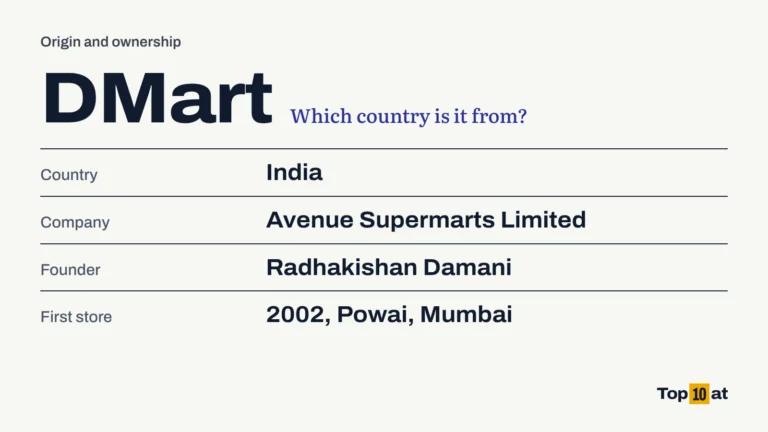
DMart is the store brand of Avenue Supermarts Limited, which Radhakishan Damani incorporated in 2000. The first store opened in Powai, Mumbai, in 2002. The company listed on the stock exchanges in March 2017.
For the year ended 31 March 2026, Avenue Supermarts reported standalone revenue of ₹66,968 crore, up 15.9% from ₹57,790 crore, and profit after tax of ₹3,224 crore, up 10.1%. Including its subsidiaries, revenue was ₹68,821 crore and profit after tax ₹2,970 crore.
How DMart makes money
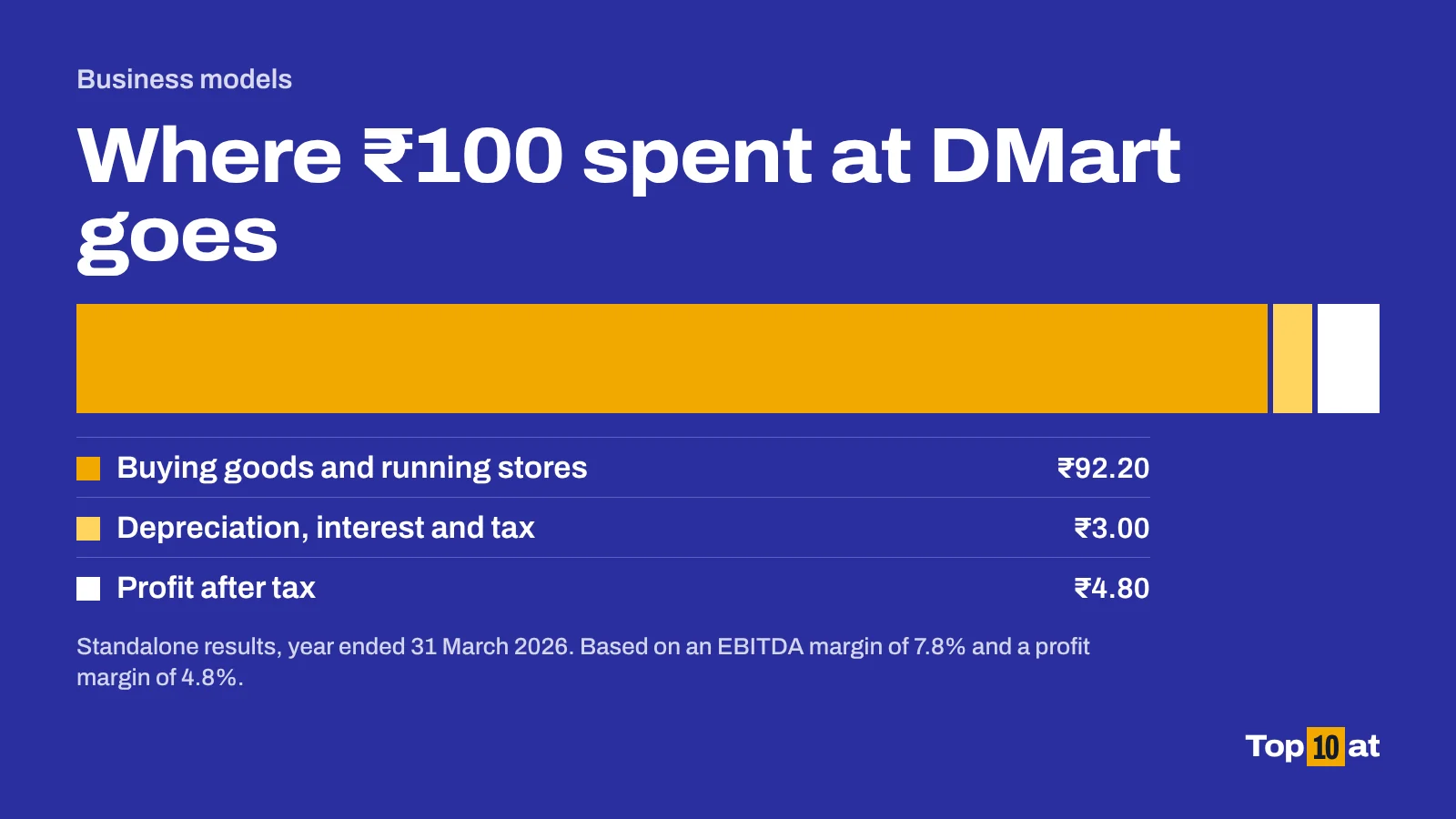
| Of every ₹100 of sales | Amount | What it covers |
|---|---|---|
| Cost of goods and running the stores | ₹92.20 | Buying stock, staff, rent where stores are leased, power and transport |
| Operating profit (EBITDA) | ₹7.80 | What is left before depreciation, interest and tax |
| Depreciation, interest and tax | ₹3.00 | Wear on stores and equipment, borrowing costs, income tax |
| Profit after tax | ₹4.80 | What the company keeps |
Everyday low cost, everyday low price
The company describes its strategy as EDLC-EDLP: everyday low cost, everyday low price. The idea is simple. Instead of running sales and promotions, DMart tries to charge less than competitors on ordinary days, on the products people buy most often. To afford that, it has to buy at better prices than they do and spend less on running its stores.
It sells in three categories: foods; non-food consumer goods such as toiletries and cleaning products; and general merchandise and apparel. The company does not publish how revenue splits between them in its results statement.
Large stores, many of them owned
DMart had 500 stores at the end of March 2026, with 20.6 million square feet of retail space between them. That is an average of about 41,200 square feet a store. One store, in Navi Mumbai, was closed for reconstruction.
From its early years DMart chose to own most of its stores instead of renting them, and to build much larger outlets than other Indian supermarket chains. Owning property takes more money at the start, and in its early years the chain expanded slowly: it had 29 stores in 2010. The benefit comes later, because a store that is owned has no rent to pay.
Each store sells a great deal. Dividing the year's revenue by the number of stores at the end of the year gives about ₹134 crore a store. The true figure for a mature store is higher, since 85 of the 500 opened during the year.
Growth comes from new stores and from old ones
The company added 85 stores in FY2025-26, including 58 in the final quarter. New stores bring new revenue.
Existing stores also sold more. In the January to March 2026 quarter, revenue at stores open for two years or longer grew 10.8%, against 8.1% in the same quarter a year earlier.
DMart Ready: the online business
DMart Ready, the company's online grocery service, started in December 2016 and operated in 18 cities at the end of March 2026. During the final quarter it stopped operating in one city. The company says it is concentrating on large metropolitan areas and that home delivery is now its preferred way of getting orders to customers.
The online business is run through a subsidiary, Avenue E-Commerce. It is small next to the stores: the whole group's revenue is only about 3% higher than the standalone store business.
Where the model is under pressure
Margins are thin and slipping slightly
Profit after tax was 4.8% of revenue, down from 5.1% the year before. The EBITDA margin moved from 7.9% to 7.8%. Revenue grew 15.9% and profit 10.1%. When a company keeps less than five rupees in a hundred, small changes in cost matter a great deal.
Expansion needs capital
Opening 85 large stores in a year, many of them on owned property, takes a lot of money before those stores earn anything.
The stock market is watching growth
Avenue Supermarts' average market value was ₹2.65 lakh crore for January to June 2026, down 4.0% from ₹2.76 lakh crore in the previous six months. It ranks 33rd among all listed companies in India.
DMart: company facts
Frequently asked questions
How does DMart make money?
By selling groceries and household goods at low prices on a small margin. In FY2025-26 it earned ₹3,224 crore of profit after tax on ₹66,968 crore of revenue, a margin of 4.8%.
Why is DMart cheaper than other stores?
Its stated strategy is everyday low cost, everyday low price: it aims to buy at competitive prices and run its stores efficiently, and to pass the saving on in regular prices instead of occasional offers.
How many DMart stores are there?
500 at 31 March 2026, with 20.6 million square feet of retail space. The company opened 85 stores during FY2025-26.
Who owns DMart?
DMart is run by Avenue Supermarts Limited, a listed company founded by Radhakishan Damani, who is its chairman.
Does DMart sell online?
Yes, through DMart Ready, which operated in 18 cities at the end of March 2026.
Sources
- Press release: financial results for FY2025-26, 2 May 2026, Avenue Supermarts, filed with the National Stock Exchange. nsearchives.nseindia.com. Accessed 11 October 2026. Source of the revenue, profit and store figures.
- DMart, Wikipedia. en.wikipedia.org. Accessed 11 October 2026. Founding, first store, store ownership and listing. Secondary source.
- Average market capitalisation of listed companies during the six months ended 30 June 2026, Association of Mutual Funds in India (AMFI). portal.amfiindia.com. Accessed 11 October 2026. Source of every market capitalisation figure and rank in this article.
- Average market capitalisation of listed companies during the six months ended 31 December 2025, Association of Mutual Funds in India (AMFI). amfiindia.com. Accessed 11 October 2026. Used for the comparison with the previous six months.