24,22,713
Vehicles sold, FY2025-26
4,47,774
Vehicles exported
₹1,74,370 crore
Net sales
₹4.41 lakh crore
Average market value, Jan to Jun 2026
Maruti Suzuki India reported total sales of 24,22,713 vehicles for the year ended 31 March 2026, its highest ever, up 8.4% from 22,34,266. Net sales were ₹174,369.5 crore, up 20.2%, and net profit was ₹14,445.4 crore.
The company is a subsidiary of Suzuki Motor Corporation of Japan. This analysis uses its annual results statement and AMFI's market capitalisation data.
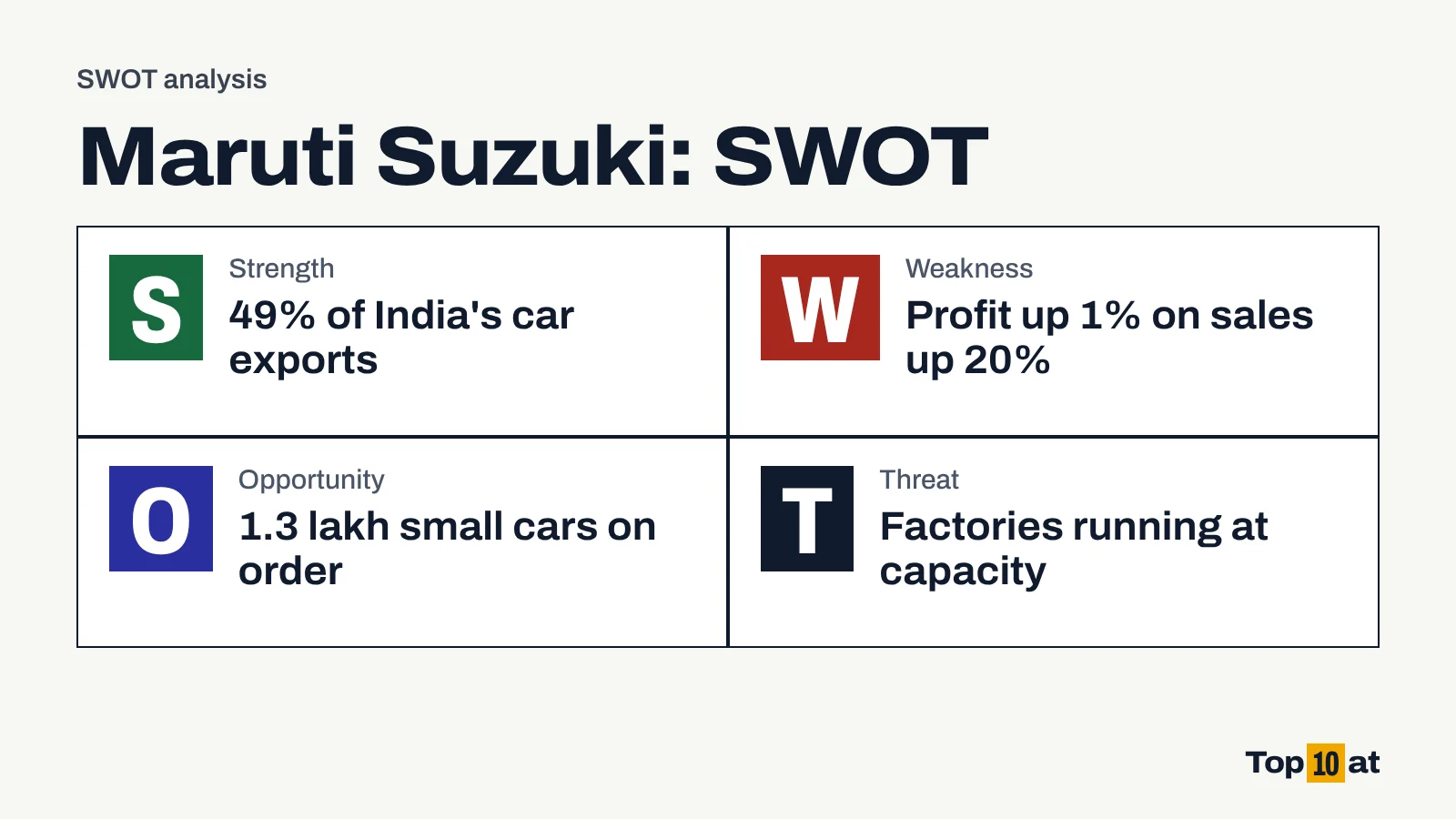
Maruti Suzuki SWOT at a glance
Strengths
- Record sales of 24.2 lakh vehicles
- 49% of India's passenger vehicle exports
- Top exporter for five years running
- Majority-owned by Suzuki of Japan
Weaknesses
- Net profit rose 1% while sales rose 20%
- Domestic sales grew only 3.9%
- Fourth-quarter profit fell 6.9%
- Sales limited by production capacity
Opportunities
- About 1.3 lakh small-car orders waiting
- GST cut lifted demand in the second half
- Exports up 34.6% in a year
- First electric car now sold in 44 countries
Threats
- Cannot build cars fast enough to meet orders
- Dealer stock down to about 12 days
- Mark-to-market losses hit quarterly profit
- Average market value fell 6.3% in six months
Strengths
Record volume
Maruti Suzuki sold 24,22,713 vehicles in FY2025-26, more than in any previous year. The final quarter was also a record, at 676,209 vehicles, up 11.8%.
The country's largest car exporter
Exports reached 4,47,774 vehicles, up 34.6% from 3,32,585. The company says it was India's top passenger vehicle exporter for the fifth year in a row and accounted for 49% of the country's passenger vehicle exports. Exports now make up 18.5% of everything it sells.
Revenue is growing faster than volume
Net sales rose 20.2% to ₹174,369.5 crore while the number of vehicles rose 8.4%. Each vehicle sold therefore brought in more money on average than the year before.
A strong parent
Suzuki Motor Corporation of Japan is the majority owner. The company raised its dividend to ₹140 a share from ₹135.
Weaknesses
Profit did not follow sales
Net profit was ₹14,445.4 crore, against ₹14,297.6 crore the year before, a rise of 1.0%. With sales up 20.2%, that means the profit earned on each rupee of sales fell. Net profit was 8.3% of net sales.
A weak final quarter for profit
Fourth-quarter net profit fell 6.9% to ₹3,590.5 crore even though sales volume and operating profit were at record levels. The company attributed the fall primarily to a mark-to-market impact, meaning a change in the recorded value of financial holdings, not in the car business.
Slow growth at home
Domestic sales rose 3.9% to 19,74,939 vehicles. Exports accounted for about 61% of the year's increase in volume. The Indian market still takes 82% of the company's output.
Not enough capacity
The company said its sales were limited by production capacity. A carmaker that cannot build enough cars leaves orders for competitors to fill.
Opportunities
A backlog of small-car orders
At the end of the year Maruti Suzuki had about 190,000 orders waiting to be filled. Around 130,000 of them were for small cars in the 18% GST bracket. The company said demand in the domestic market grew steeply in the second half of the year after the GST reduction.
Exports
Exports grew by more than a third in one year. With 18.5% of sales now going abroad, the company is less dependent on the Indian market than it was.
Electric vehicles
The e VITARA, which the company calls its first battery electric vehicle, is made in India and was exported to 44 countries during the year. That gives Maruti Suzuki a start in a part of the market where it had no product before.
Threats
Its own production limit
Unfilled orders are an opportunity only if the cars can be built. Dealer stock was down to about 12 days at the end of the year, which shows how little slack there is. Until new capacity is available, growth depends on how fast the factories can be expanded.
Earnings that swing with financial markets
The fall in fourth-quarter profit came from mark-to-market movements, not from the car business. Reported profit can therefore move for reasons unrelated to how many cars the company sells.
Demand that depends on tax policy
The second-half surge followed a cut in GST. Demand created by a tax change can fade once buyers who were waiting have bought.
The market's verdict
Maruti Suzuki's average market value was ₹4.41 lakh crore for January to June 2026, down 6.3% from ₹4.70 lakh crore in the previous six months. It ranks twelfth among all listed companies in India.
How to read this analysis
A SWOT analysis sorts what is known about a company into four boxes: strengths and weaknesses, which are internal, and opportunities and threats, which come from outside.
Every figure here comes from the company's own results for the year ended 31 March 2026 or from AMFI's market capitalisation list. The sorting into boxes, and the judgment about what matters most, is ours. It is a way of organising public information. It is not investment advice and it is not the company's own view of itself.
Maruti Suzuki: company facts
Frequently asked questions
What is Maruti Suzuki's biggest strength?
Volume and exports. It sold a record 24,22,713 vehicles in FY2025-26 and accounted for 49% of India's passenger vehicle exports.
What is Maruti Suzuki's main weakness?
Profitability did not keep pace with sales in FY2025-26. Net sales rose 20.2% but net profit rose only 1.0%. The company also said production capacity limited its sales.
How many cars did Maruti Suzuki sell in FY2025-26?
24,22,713 vehicles in total: 19,74,939 in India and 4,47,774 exported.
Does Maruti Suzuki make electric cars?
Yes. The e VITARA is its first battery electric vehicle. It is made in India and was exported to 44 countries in FY2025-26.
Who owns Maruti Suzuki?
Suzuki Motor Corporation of Japan is the majority owner. The company began in 1981 as Maruti Udyog, set up by the Government of India.
Sources
- Press release: financial results for FY2025-26, 28 April 2026, Maruti Suzuki India, filed with the National Stock Exchange. nsearchives.nseindia.com. Accessed 11 October 2026. Source of the sales, export and financial figures.
- Average market capitalisation of listed companies during the six months ended 30 June 2026, Association of Mutual Funds in India (AMFI). portal.amfiindia.com. Accessed 11 October 2026. Source of every market capitalisation figure and rank in this article.
- Average market capitalisation of listed companies during the six months ended 31 December 2025, Association of Mutual Funds in India (AMFI). amfiindia.com. Accessed 11 October 2026. Used for the comparison with the previous six months.
- Maruti Suzuki, Wikipedia. en.wikipedia.org. Accessed 11 October 2026. Company background. Secondary source.