₹63,763 crore
Turnover, FY2025-26
23.6%
EBITDA margin
20
Brands above ₹1,000 crore
₹5.29 lakh crore
Average market value, Jan to Jun 2026
Hindustan Unilever reported turnover of ₹63,763 crore for the year ended 31 March 2026, up 5%, with underlying volume growth of 4%. Profit after tax before exceptional items was ₹10,324 crore, and reported profit after tax was ₹10,652 crore.
The company sells through four divisions: Home Care, Beauty and Wellbeing, Personal Care, and Foods. Its reported figures for the year exclude the ice cream business. This analysis draws on its results statement and on AMFI's market capitalisation data.
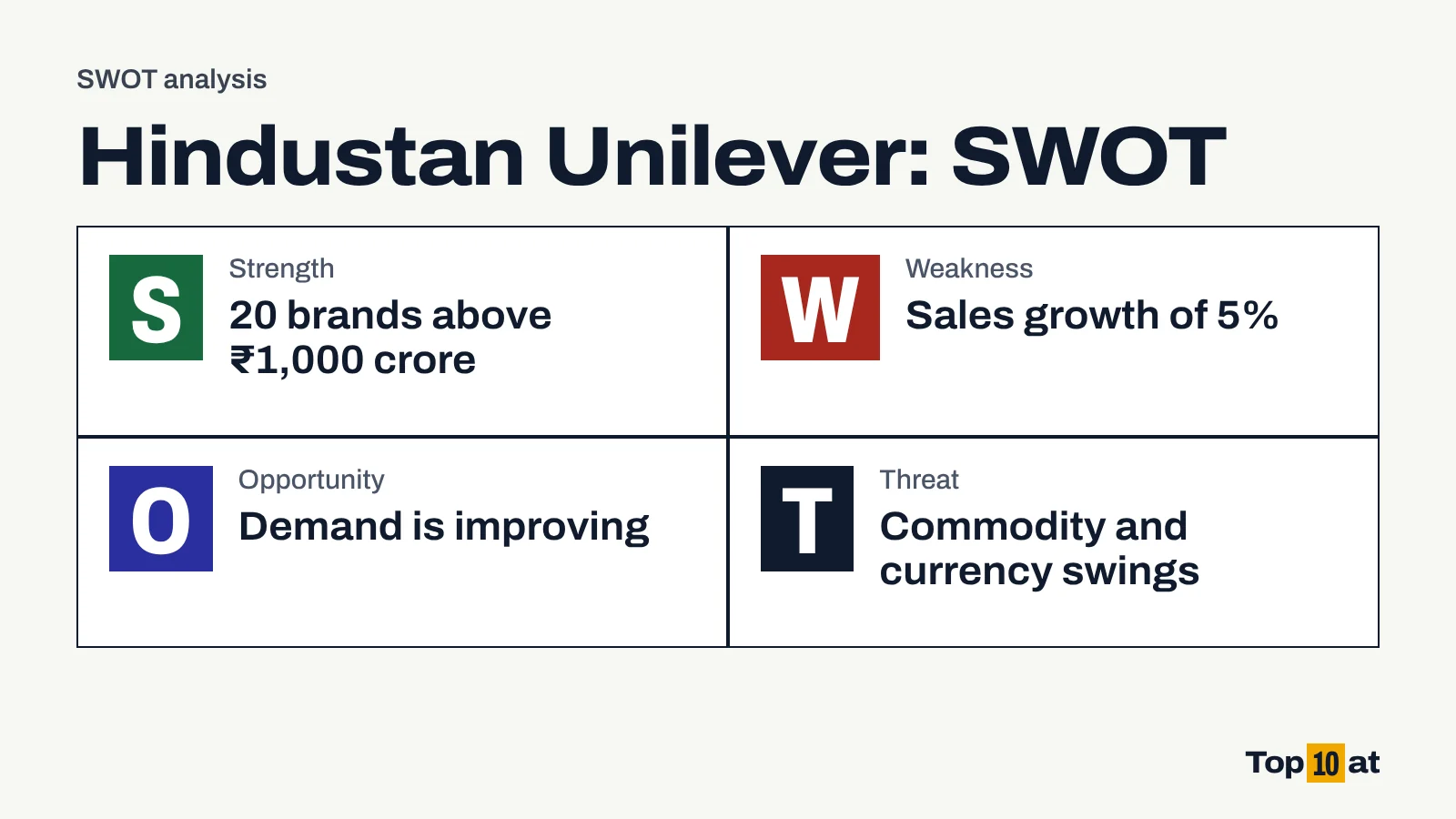
Hindustan Unilever SWOT at a glance
Strengths
- 20 brands with turnover above ₹1,000 crore each
- EBITDA margin of 23.6%
- Volume growth of 4%, so growth is not only price
- Backed by Unilever, which owns about 61.9%
Weaknesses
- Turnover grew 5%
- Almost entirely dependent on the Indian consumer
- Personal Care and Foods grew more slowly than Home Care
Opportunities
- Management reports an improved demand environment
- Home Care grew 9% in the March quarter
- Beauty and Wellbeing grew 8% in the March quarter
- Brands still crossing the ₹1,000 crore mark
Threats
- Commodity and currency volatility
- Geopolitical tension feeding into input costs
- Only just inside India's ten most valuable companies
Strengths
Twenty very large brands
Vaseline and Sunsilk each crossed ₹1,000 crore in annual turnover during FY2025-26. That took the number of HUL brands above that mark to 20. A portfolio this broad means no single product decides the company's year.
High margins
HUL's EBITDA margin was 23.6%, which the company described as the higher end of its guidance. Profit after tax before exceptional items was ₹10,324 crore, about 16% of turnover.
Growth came from volume
Underlying sales growth was 5% and underlying volume growth was 4%. Most of the increase therefore came from selling more goods, not from raising prices.
Cash returned to shareholders
The board proposed a final dividend of ₹22 a share on top of an interim dividend of ₹19, a total payout of ₹9,633 crore for the year.
A global parent
Unilever plc owns about 61.9% of HUL, so it is part of one of the world's largest consumer goods groups.
Weaknesses
Growth is modest
A 5% rise in turnover is steady but slow. HUL is a large, mature business, and growth is harder to find at that size.
One country
HUL's business is selling to Indian households, so its results follow Indian consumer spending closely. Management's own commentary on the year is about demand conditions in India.
Uneven divisions
In the March 2026 quarter Home Care grew 9% and Beauty and Wellbeing 8%, while Personal Care and Foods each grew 5%. The company's statement gives quarterly growth by division but not full-year figures, which limits how closely an outsider can track them.
Opportunities
Better demand
Chief executive Priya Nair said FY2026 "witnessed an improved demand environment driven by supportive macro-economic policies". If that continues, a company with HUL's distribution is well placed to benefit.
The faster-growing divisions
Home Care and Beauty and Wellbeing ended the year growing at 9% and 8%. If those rates hold, they will lift the company's overall growth above the 5% it reported for the year.
More brands reaching scale
Two brands passed ₹1,000 crore in a single year, which shows that parts of the portfolio are still growing quickly.
A sharper portfolio
The company said it had sharpened its portfolio during the year. It sold a stake in Nutritionalab, and its reported results exclude ice cream. Fewer, larger businesses are easier to manage.
Threats
Commodity and currency volatility
The results statement says heightened geopolitical tensions have caused "commodity and currency volatility". HUL buys raw materials whose prices are set on world markets. The company says it is responding with savings, supply chain measures and "calibrated pricing", which means higher prices for shoppers if costs keep rising.
A volatile operating environment
Management's own description of the outlook is that HUL is "well positioned to navigate this volatile operating environment". The company expects the volatility to continue.
A slipping position among India's largest companies
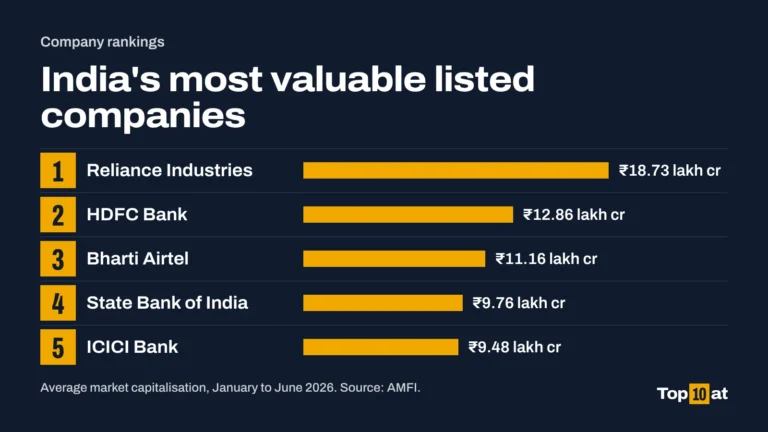
HUL's average market value for January to June 2026 was ₹5.29 lakh crore, 1.8% lower than in the previous six months. It held tenth place in AMFI's list, but LIC in eleventh is only about 2% behind. Our ranking of India's largest companies has the detail.
How to read this analysis
A SWOT analysis sorts what is known about a company into four boxes: strengths and weaknesses, which are internal, and opportunities and threats, which come from outside.
Every figure here comes from the company's own results for the year ended 31 March 2026 or from AMFI's market capitalisation list. The sorting into boxes, and the judgment about what matters most, is ours. It is a way of organising public information. It is not investment advice and it is not the company's own view of itself.
Hindustan Unilever: company facts
Frequently asked questions
What is HUL's biggest strength?
Its brands. Twenty of them each have annual turnover above ₹1,000 crore, and the company earned an EBITDA margin of 23.6% in FY2025-26.
What is HUL's main weakness?
Slow growth. Turnover rose 5% in FY2025-26 to ₹63,763 crore, with volume up 4%.
Who owns Hindustan Unilever?
Unilever plc owns about 61.9%. The rest is held by public shareholders, and the shares are listed in India.
Does HUL still own its ice cream business?
Its reported results for FY2025-26 exclude the ice cream business for the whole period. The results statement does not give further detail on it.
Sources
- Press release: results for the March quarter and financial year 2026, 30 April 2026, Hindustan Unilever, filed with the National Stock Exchange. nsearchives.nseindia.com. Accessed 11 October 2026. Source of the financial figures and management comments.
- Average market capitalisation of listed companies during the six months ended 30 June 2026, Association of Mutual Funds in India (AMFI). portal.amfiindia.com. Accessed 11 October 2026. Source of every market capitalisation figure and rank in this article.
- Average market capitalisation of listed companies during the six months ended 31 December 2025, Association of Mutual Funds in India (AMFI). amfiindia.com. Accessed 11 October 2026. Used for the comparison with the previous six months.
- Hindustan Unilever, Wikipedia. en.wikipedia.org. Accessed 11 October 2026. Company background. Secondary source.