Buying an office building takes crores of rupees and a great deal of management. A REIT pools money from many investors to buy such buildings, collects the rent, and passes most of it on. Each investor holds units, and each unit is a share in the whole portfolio.
India's REIT rules date from 2014, when SEBI issued its regulations. The first REITs listed some years later. This page explains how the structure works, using SEBI's own guidance and one listed REIT as an example.
The rules a REIT must follow
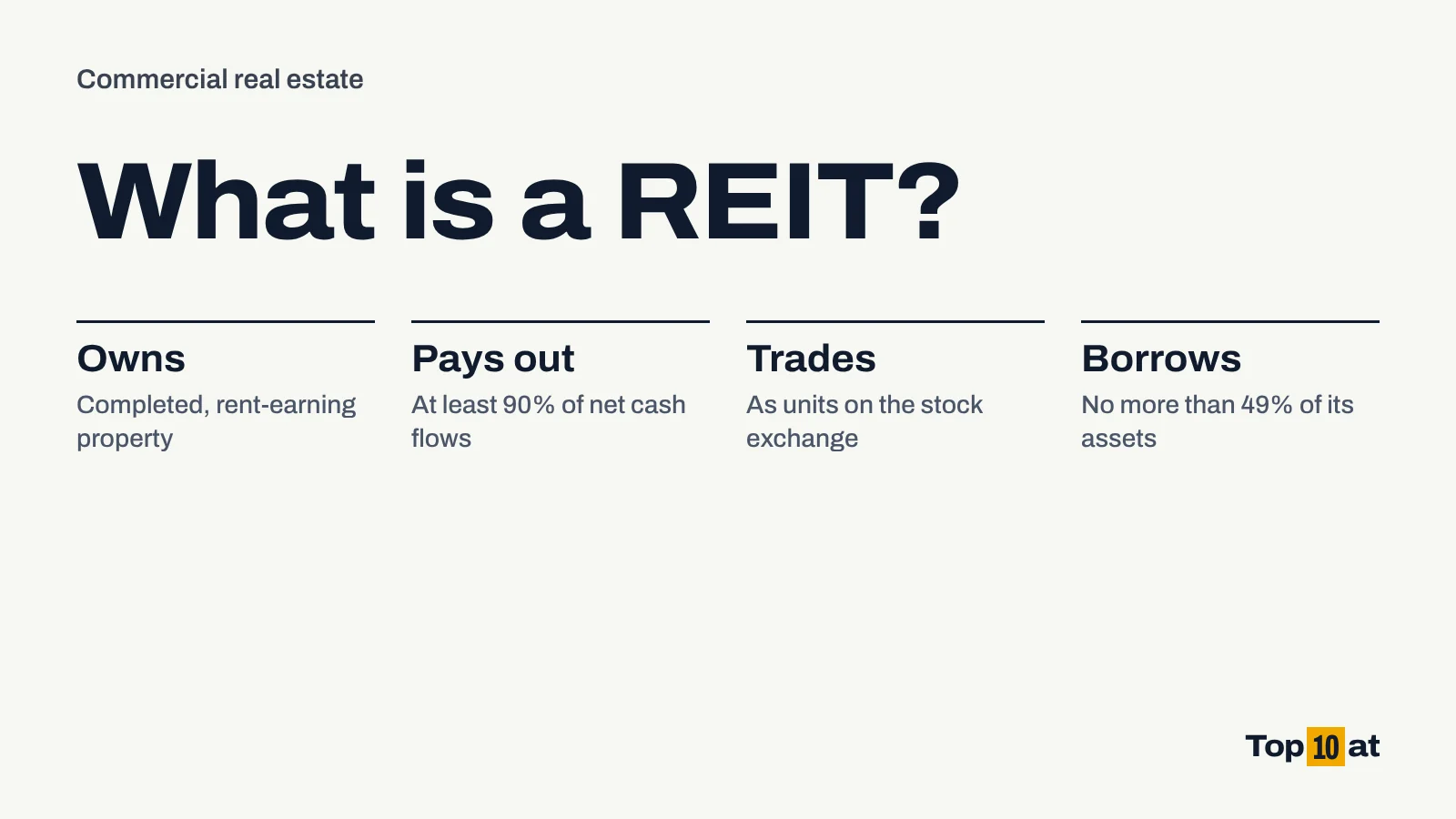
Three of these rules shape what a REIT is like to own.
The payout rule means a REIT cannot hoard cash. Most of what it earns in rent, after costs, has to reach unitholders. That makes it an income investment first.
The listing rule means you are not locked in. You can sell your units on the exchange on any trading day, at the market price.
The borrowing limit restricts how much debt a REIT can pile on. Debt cannot exceed 49% of its assets.
Who runs a REIT
| Party | Role | SEBI requirement |
|---|---|---|
| Sponsor | Sets up the REIT and usually contributes the first properties | Combined net worth of at least ₹100 crore, with each sponsor at least ₹20 crore |
| Manager | Runs the properties and makes investment decisions | Net worth or net tangible assets of at least ₹10 crore |
| Trustee | Holds the assets on behalf of unitholders and oversees the manager | Must be a SEBI-registered debenture trustee, and not an associate of the sponsor or manager |
The separation matters. The trustee is independent of the sponsor and the manager, so the people who run the properties do not also hold them.
A real example: Embassy Office Parks REIT
Embassy Office Parks REIT shows what these rules produce in practice. As of 30 June 2026 it owned 43.5 million square feet of completed offices in Bengaluru, Mumbai, Pune, Noida and Chennai, let to 285 occupiers, with 90% of the space occupied. It also owned hotels and a solar park.
In the April to June 2026 quarter it earned revenue of ₹1,241 crore and net operating income of ₹1,020 crore, and declared a distribution of ₹6.31 a unit. For the full year to March 2026 its distributions came to ₹25.28 a unit.
Because it is listed, the REIT publishes figures for every property each quarter: the area, how much is let, the rent and an independent valuation. Our ranking of Embassy REIT's office parks is built from those disclosures, and the profiles of Embassy Manyata and Embassy Oxygen go into more detail.
How a unitholder earns
There are two sources of return.
- Distributions. The REIT pays out most of its cash flow, usually every quarter. This is the larger and steadier part.
- Changes in the unit price. Units trade on the exchange, and the price can rise or fall.
Neither is guaranteed. Distributions depend on the buildings staying let at good rents. The unit price depends on what other investors are willing to pay.
What can go wrong
A REIT is a property business, and it carries a property business's risks. These follow from how the structure works.
- Vacancy. If tenants leave and space stays empty, rent falls and so do distributions. Occupancy differs a great deal between buildings: within the Embassy portfolio it ranges from 24% at one Pune park to 100% at seven properties.
- Rent levels. Leases come up for renewal. If market rents have fallen, the new lease pays less.
- Interest rates. REITs borrow, within the 49% limit. Higher interest costs leave less to distribute.
- Price swings. The unit price moves with the stock market, even when the rent has not changed.
- Concentration. A REIT may depend heavily on one city or a few large tenants.
This page explains how REITs work. It is not a recommendation to buy or sell any REIT.
Frequently asked questions
What is a REIT in simple words?
A trust that owns rent-earning buildings on behalf of many investors. You buy units on the stock exchange, and the trust pays you a share of the rent it collects.
How much of its income must a REIT pay out?
At least 90% of its net distributable cash flows, at least once every six months, under SEBI's rules.
What is the minimum investment in a REIT?
On the stock exchange the trading lot is one unit, so the minimum is the price of a single unit. In an initial public offer, SEBI's FAQ gives the minimum application as ₹10,000 to ₹15,000.
Are REITs regulated in India?
Yes. A REIT must be registered with SEBI and follow SEBI's REIT regulations, which cover what it can own, how much it can borrow and how much it must distribute.
Is a REIT the same as buying property?
No. You own units in a trust, not a building. You cannot use the property, but you can sell your units on the exchange at any time, which you cannot do with a building.
Sources
- Frequently asked questions for real estate investment trusts, Securities and Exchange Board of India (SEBI). sebi.gov.in. Accessed 11 October 2026. Definition, the parties to a REIT, distribution, listing, minimum subscription and borrowing limit.
- Q1 FY2027 earnings materials, 30 July 2026, Embassy Office Parks REIT. eopwebsvr.blob.core.windows.net. Accessed 11 October 2026. Area, occupancy, lease term, rent and valuation for each property as of 30 June 2026.
- Outcome of board meeting: financial results for FY2026, 27 April 2026, Embassy Office Parks REIT, filed with the National Stock Exchange. nsearchives.nseindia.com. Accessed 11 October 2026. Distribution per unit for the year to March 2026.
- Real estate investment trust, Wikipedia. en.wikipedia.org. Accessed 11 October 2026. Background on REITs in India. Secondary source.